
Date: September 9, 2009 (Mental Urban Transformation – A Friend’s Inner Voice Expressed and Manifesto-Satoshi Nakamato)
Systemic Fatigue, the Desire for Rootedness, the Destruction of Truths, and an Internal Dialogue on the Meaning of Life
An Inner Revolution That Begins With Exhaustion
On the verge of exhaustion, a revolution begins. At the limits of body and mind, an invisible spark of rebellion ignites. As I write these lines, I feel the weariness echoing within me, rooted not only in my muscles but in the deepest layers of my being. This weariness is not ordinary exhaustion; it is the harbinger of a call, an awakening, an inner revolution. In the speed of the modern world, behind the mask of productivity and busyness, a void grows concerning the essence of humanity. Every day, as I rush towards new achievements, I realize that something is missing within me, that meaning is becoming increasingly blurred. This weariness is not only of the body, but also of the soul, of beliefs, and of values.
Existential weariness is more than just depression or burnout; it is a state of uncertainty regarding the meaning and direction of life. As Viktor Frankl pointed out in his logotherapy, the search for meaning is central to humanity; however, the speed and consumption-oriented nature of modern life weakens this meaning, and internal values give way to external measures of success. In the shadow of digitalization and social comparison, we find our own stories inadequate and become dependent on the approval of others. We become isolated; seemingly connected, but our relationships are superficial, our sense of belonging weakens, and our identity integrity is compromised. As in Heidegger’s concept of “addiction,” we forget the state of “being” in the constant state of “doing.” This is the beginning of systemic fatigue and an inner revolution.
This revolution is not a collapse, but a call. Fatigue is not a flaw to be suppressed, but a gateway to truth. Within myself, listening to the voice of this fatigue, I embark on a journey to reconstruct meaning. Because I know that true transformation is the fruit not of external successes, but of inner silence and confrontation. This manifesto is a revolution born from this fatigue: a desire for rootedness, the destruction of established truths, and an inner dialogue about the meaning of life.
The Deconstruction of Truth: The Collapse and Questioning of Belief Systems
Every revolution begins with destruction. My revolution, too, began with the destruction of truths, the collapse of my belief systems. Values I once thought unshakeable cracked one by one; the truths I believed in melted in the fire of questioning. Like the anti-hero in Dostoevsky’s Notes from Underground, I began to tear down the walls within myself. The roles imposed by society, the absolute nature of logic and rationality, were prison walls. As the Underground Man says, man is not merely a being driven by reason; he is free with his emotions, his contradictions, his irrational sides.
The collapse of belief systems is not only the destruction of religious or ideological dogmas. It is also the questioning of modernity, science, progress, and the cult of success. Nietzsche’s proclamation of “God is dead” is not merely a theological claim, but the collapse of all absolute values and systems of meaning. Nothing is inherently true anymore; everything is the object of questioning, criticism, and reinterpretation. Kierkegaard’s existential angst, Sartre’s assertion that “existence precedes essence,” condemns humanity to create its own meaning. There is no longer an external truth; truth is a process that is constantly re-established.
The destructive power of ideologies is also a harbinger of social collapse. The great ideological conflicts of the 20th century were the source of deep wounds, othering, and massacres not only between two poles but also within the same ideology. Every system—capitalist, socialist, religious, or secular—when it absolutizes its own norms, condemns humanity to swing in a void like a pendulum. Today, the rise of religions at the social level has ultimately created the greatest moral decay, leading to a questioning of values. The coming century may well witness the plague of ideology transforming into a modern religion.
In the midst of this destruction, critique is a process; it carries the dogmas of the past into the present and the future, reconstructing them constantly. Authority and tradition are not immutable structures, but constitutive possibilities within the process. True authority is the product of recognition, respect, and authentic synthesis. In every new encounter, tradition is re-established; it is not a transcendent metaphysics, but a creative process.
I, as a friend, am searching for new meaning amidst the ruins of old truths as I navigate through this destruction. For I know that every destruction is the beginning of a new construction. Truth is not a fixed essence; it is a process that is re-established each time. And in this process, I begin to build my own inner authority, my own meaning, my own system.
Redefining Life: Inverting Maslow’s Pyramid and a Vibrational Interpretation of Life
Maslow’s Pyramid: Questioning a Hierarchy
Maslow’s hierarchy of needs has been presented as a universal schema of human motivation. It’s a pyramid that starts with physiological needs and rises through security, belonging, respect, and self-actualization. However, this pyramid now feels too narrow for me. Because life isn’t a fixed hierarchy; it’s a dynamic, permeable, and vibrational process.
Maslow’s theory was shaped by clinical observations within the individualistic culture of the West. However, in different cultures, especially in collectivist and community-oriented societies like Turkey, the order and priority of needs can change. Moreover, even Maslow himself acknowledges that needs don’t progress in a rigid order, and that most people are partially satisfied with all their basic needs simultaneously. Creative and mystical individuals can reach the highest peaks of self-actualization even when they can’t meet their basic physiological needs.
Maslow’s pyramid is now being reversed by the influence of digitalization, social media, and capitalism. Visibility, interaction, and approval can now even outweigh physiological needs. The dopamine mechanism is replacing real hunger with digital rewards. Our stomachs are hungry, but our brains are trying to satisfy themselves with notifications. Digital identities are overshadowing our real identities; the need for belonging is turning into digital community addiction. Self-actualization is measured by visibility rather than authenticity. The capitalist system is transforming digital characters and their needs into an economic model.
The Inverted Pyramid: A New Model of Life
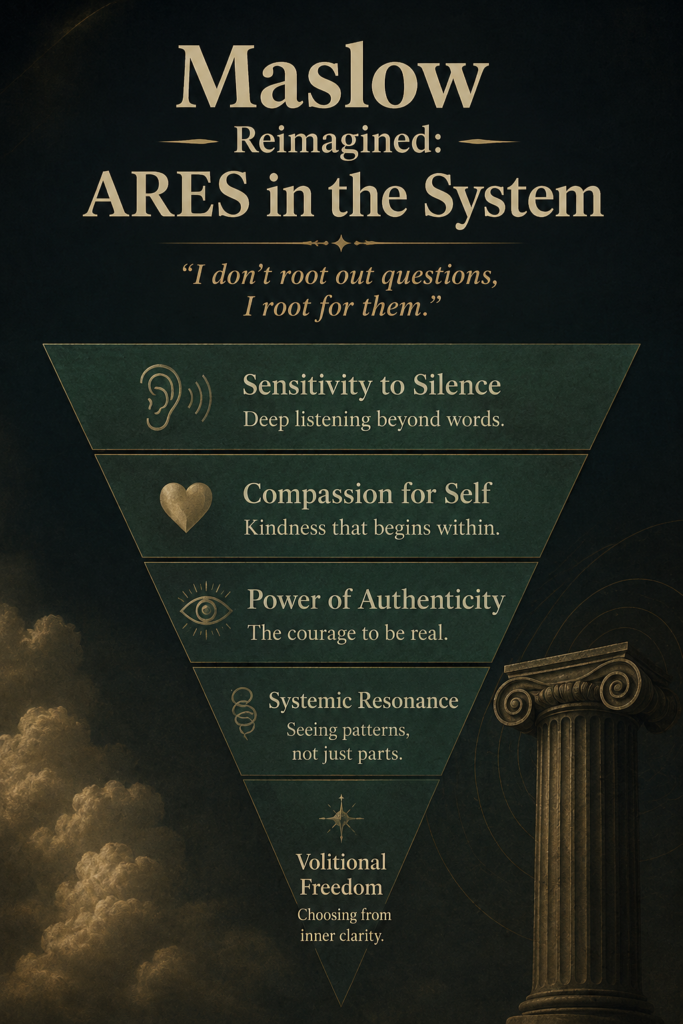
Therefore, I’m inverting Maslow’s pyramid. Now, instead of self-actualization at the top, there’s the desire for rootedness at the bottom. Because true transformation begins at the very foundation, with rootedness, with a sense of belonging, with the vibrational wholeness of existence. The inverted pyramid is a dismantling of the classical hierarchy; it’s a dynamic and integrated process where needs intertwine.
The inverted pyramid is also a metaphor: the broadest base is at the deepest roots; the narrowest point is at the apex. Life vibrates not from top to bottom, but from bottom to top, from roots to the sky. Every need flows into another; belonging, security, respect, and self-actualization permeate each other. In this model, a person lives not only for themselves but also for the collective consciousness. The frequency of each individual contributes to the collective consciousness; personal awareness becomes the seed of social transformation.
The Vibrational Interpretation of Life: Between Metaphysics and Science
The meaning of life lies not only in the fulfillment of needs, but also in the vibrational fabric of existence. According to the Law of Vibration, everything in the universe is in motion; every atom, every cell vibrates at its own unique frequency. Our thoughts, emotions, and actions create our own vibration and determine our interaction with the world. Positive vibrations attract positive experiences; negative vibrations attract negative experiences. Every person emits their own frequency; this frequency shapes both individual and collective reality.
The vibrational interpretation of life is not only a metaphysical concept; it is also supported by quantum physics and the understanding of energy. It is scientifically accepted that everything is composed of energy, and this energy vibrates at various frequencies. Emotions, thoughts, and the physical environment affect our vibrational energy. High frequency attracts light and positive experiences; low frequency attracts heavy and negative experiences. Therefore, the meaning of life is found not only in external conditions, but also in internal vibration, conscious choice, and collective resonance.
The Meaning of Life: Philosophical and Everyday Inquiry
The meaning of life has been a subject of debate among philosophers and thinkers for centuries. Socrates’ call to “know thyself,” Plato’s world of Forms, Aristotle’s understanding of virtue, Nietzsche’s destruction of values and creation of new meaning, Kierkegaard’s existential angst, Sartre’s emphasis on freedom… all demonstrate that the meaning of life lies not in a fixed essence, but in individual and collective creation.
In the modern age, mindfulness and awareness techniques offer ways to integrate the search for meaning into daily life. Meaning is not merely a mental exercise, but plays a critical role in personal growth and the pursuit of fulfillment. Each individual must find their own path; the search for meaning is individual, and each individual creates their own meaning.
I, as a friend, now see life not as a pyramid, but as a vibration, a rooting, a collective resonance. Meaning is not outside; it is within me, in my relationships, in social energy, in vibrational wholeness. And in this wholeness, the frequency of each of us contributes to the collective consciousness. Individual awakening is the purest form of collective revolution.
The Desire to Put Down Roots: The Will to Build a New Life and Systemic Rooting
The Psychodynamics of Rooting: Belonging and Identity
The desire for rootedness is one of the deepest human needs. The yearning to belong to a place, a community, an identity is a cornerstone of existence. Rooting is not only about a physical space; it’s also about holding on to an emotional, social, and spiritual foundation. A sense of belonging is fundamental to identity formation, setting goals and objectives, stability and steadfastness, and building strong social bonds.
Those who struggle with rootedness cannot feel a sense of belonging; they lead a nomadic life, their sense of belonging weak. This is not merely an individual problem; it’s a social, historical, and cultural cycle. The centuries-long nomadic life of the Turks demonstrates the historical origins of the need for belonging and rootedness. Large migrations within families, exiles, loss of land, and the severing of bonds of belonging create unconsciously recurring cycles. Breaking this cycle, choosing rootedness, requires conscious awareness and emotional integration.
Rooting begins not only with external conditions but also with internal emotions. Without emotional belonging, mechanical rooting is impossible. Those whose root chakra is most blocked are often individuals who haven’t developed a sense of belonging or who didn’t spend enough time with their parents as children. Those seeking to ground themselves must identify where their emotions are flowing and when that connection was broken. Because grounding is the product of an inner integration where emotional logic comes into play.
Systemic Rooting: The Desire to Create a New Life
The desire to put down roots merges with the wish to build a new life. In the modern world, constantly changing conditions, migrations, job changes, and social disconnections make putting down roots difficult. However, putting down roots requires not only external stability but also internal integrity and systemic balance. Systemic rooting is about an individual establishing their own internal system, rebuilding their emotional, mental, and social connections.
In this process, collective consciousness and social energy have a powerful influence on individual transformation. Jung’s concept of collective consciousness encompasses the shared subconscious, cultural background, common traumas, and belief systems of the individuals who make up society. Each individual’s frequency contributes to the collective consciousness; personal awareness becomes the seed of social transformation. Meditation, nature walks, and breathing exercises facilitate rooting by balancing the energy field. Joining communities and coming together with like-minded individuals creates a powerful synergy in the collective consciousness.
Putting down roots is not only an individual need but also a social necessity. Each individual’s journey of healing resonates in the collective consciousness. Individual awakenings are, in fact, the purest form of a collective revolution. “If you change, the world changes.” Therefore, the desire to put down roots is a call not only for myself, but also for the collective consciousness.
Declaration of Authority: Redefining Internal Authority
The Crisis of Authority and Intrinsic Competence
In the modern world, the concept of authority is experiencing a major crisis. Traditional authorities – the state, religion, family, social norms – have been shaken; the individual is forced to find their own internal authority. Authority is not merely an external force; it is an internal competence, a relationship of recognition and respect. True authority is not an authoritarian domination; it is a constitutive, creative, and pluralistic relationship in the process.
The new content of authority is related to both the past and the present and future. Recognition, respect, and acceptance are the foundation of true authority. Authority is a process that is constantly re-established; it is not an absolute, unchanging structure. Instead of subjecting authority to a completely destructive critique, it is necessary to preserve it by removing it from its historically imposed authoritarian meaning and changing its content. True authority is the product of an original synthesis created by resorting to one’s own judgment.
Inner Authority: Humanist Conscience and Freedom
In the modern world, the concept of authority is experiencing a major crisis. Traditional authorities – the state, religion, family, social norms – have been shaken; the individual is forced to find their own internal authority. Authority is not merely an external force; it is an internal competence, a relationship of recognition and respect. True authority is not an authoritarian domination; it is a constitutive, creative, and pluralistic relationship in the process.
The new content of authority is related to both the past and the present and future. Recognition, respect, and acceptance are the foundation of true authority. Authority is a process that is constantly re-established; it is not an absolute, unchanging structure. Instead of subjecting authority to a completely destructive critique, it is necessary to preserve it by removing it from its historically imposed authoritarian meaning and changing its content. True authority is the product of an original synthesis created by resorting to one’s own judgment.
Authorization Notice: I’m Building My Own System
I, a friend, declare my own inner authority. I am no longer subject to external authorities, social norms, or traditions. I act according to my own judgment, my own conscience, and my own intuition. My authority does not come from outside; it originates from within, from my humanist conscience, from my unique synthesis. I am building my own system: a system built on rootedness, belonging, freedom, creativity, and collective consciousness.
In this system, authority is not a fixed power; it is a constitutive, creative, and pluralistic relationship in the process. In each new encounter, tradition is re-established; it is not a transcendent metaphysics, but a creative process. Authority is shaped not only by the accumulation of the past, but also by the creative encounters of the present and the future. Inner authority merges with freedom, courage, and humanist conscience. And in this merging, true transformation begins.
Visual Metaphors: The Inverted Pyramid and the Visual Representation of the Rooted System
The Inverted Pyramid: A Symbol of Destruction and Reconstruction
The inverted pyramid symbolizes the destruction of the classical hierarchy and the construction of a new model of life. The traditional pyramid places the widest base at the bottom and the narrowest apex at the top. The inverted pyramid, however, places the widest base at the roots and the narrowest apex at the top. This represents a model where needs vibrate not from top to bottom, but from bottom to top, from roots to sky.
The inverted pyramid is also known as a news writing technique: the most important information at the beginning, details below. Philosophically, this technique shows that the meaning of life lies fundamentally in the roots, in the sense of belonging and being rooted; all other needs stem from this foundation. The inverted pyramid is a metaphor for destruction and reconstruction, rooting and rising, a dynamic and integrated process.
The Rooted System: The Power of Metaphor in Visual Communication
The rooted system, like the roots of a tree, symbolizes the deep-seated bonds between the individual and the community. Visual metaphors are the most powerful way to express abstract concepts with concrete images. The brain processes metaphors not only as language but also as a real experience; metaphors activate both the language and visual centers of the brain, reinforcing and making meaning permanent.
In visual communication, the inverted pyramid and the rooted system are symbols of both individual and collective transformation, destruction and reconstruction, belonging and freedom. The inverted pyramid represents the destruction of old truths; the rooted system represents the construction of a new life, a new meaning, a new collective consciousness. These visual metaphors are not only aesthetic but also instruments of philosophical, psychological, and social transformation.
Sketches of Visual Metaphors: The Inverted Pyramid and the Rooted System
Inverted Pyramid Illustration: The widest base is at the roots, the narrowest point at the apex. An energy flow rising from the roots towards the sky. Different needs are represented in each layer with colors and symbols. Rooted System Illustration: Like the roots of a tree, the deep connections of the individual and the community. Belonging at the roots, security and respect in the trunk, self-realization and collective consciousness in the branches. Each root symbolizes the frequency, the vibration of an individual or community. Vibrational Life Illustration: The vibrational texture of life with waveforms, frequency lines, and color transitions. The frequency of each individual contributes to the collective resonance. These visual metaphors are not merely images; they are philosophical manifestos, calls to action. With every glance, they whisper a new meaning, a new inspiration, a new beginning.
Starting in Silence: Micro-Beginnings and Authority Born in Silence
The Power of Silence: The Birth of the Inner Kingdom
True transformation begins in silence. In a world where noise and distractions have become commonplace, the greatest leaps are made in silence. The decisions that will truly change your life are not found in crowds, but in the silent vows you make within yourself. True success is built with inner determination, without sharing or announcement. Change that begins in silence starts in unseen realms. The small but determined steps you take within your inner world will carry you to a point where you will make a big difference in the outside world.
As Raja Yoga teaches, true kingship is not about conquering the outer world, but the inner realm. For the person who loses their way in the chaos of the mind and the storm of emotions, silence becomes a compass. It says, “Know thyself,” because what is hidden within you is the secret of the entire universe. When the mind is calm like a lake, truth reveals itself. One understands that one is neither body nor thought; one feels that one is a vibration, one with the infinite. True kingship is a dominion that is invisible from the outside but reigns within.
Micro-Beginnings: Authority Born in Silence
Big changes are often hidden not in big steps, but in small, subtle decisions made without being noticed. Micro-decisions are small choices an individual makes unconsciously throughout the day. While they may seem insignificant on their own, their repetitive nature creates cognitive patterns. In behavioral science, this is known as the “compound effect”: small changes accumulating to produce big results. Major transformations that change the course of life often stem from accumulated small decisions.
Micro-decisions are explained by habit formation theory. The repetition of small behaviors strengthens the brain’s neural connections, leading to the automatization of the behavior. Taking a deep breath before looking at your phone screen every morning can, after a while, become a mindfulness-based way of life. Decision fatigue reduces our capacity to make the right decisions throughout the day; therefore, small but positive choices made in the morning help maintain mental balance for the rest of the day. Micro-decisions optimize not only behavior but also the quality of decision-making.
In community-oriented cultures like Turkey, individuals often seek the approval of their environment when making big decisions. Micro-decisions strengthen internal orientation rather than external validation. Doing a small favor for yourself every day, learning to ask the question, “What is good for me?”, increases one’s sense of autonomy. This nourishes intrinsic motivation, a fundamental component of psychological well-being.
Authority Born in Silence: The Rebirth of Inner Authority
Micro-initiatives that begin in silence are the rebirth of inner authority. Being able to continue producing when no one is watching is a sign of true self-confidence, inner strength, and determination. External approval loses its importance; producing instead of sharing, moving forward instead of expecting applause… This is how an effective life begins. Achieving your plans instead of just talking about them is far more effective in the long run. People remember what you accomplish, not what you say. So be silent and work. Everything will speak for itself in time.
Discipline is revealed in solitude. If you can continue when no one is watching, your inner strength is solid. On such a journey, you don’t need external praise. Because neither criticism will destroy you, nor praise will mislead you. Procrastination breeds regret. The best time to start is now. Neither motivation nor perfect conditions are necessary. Make this promise to yourself: “Today, I will do my best.” And repeat this every day. The rest will follow naturally.
The Call and the Nature of This Manifesto as a Collective Invitation
I, a friend, am writing this manifesto not only for myself, but for the collective consciousness. In the inner dialogue of systemic weariness, the yearning for rootedness, the destruction of established truths, and the meaning of life, the voice of each of us resonates. This manifesto is not merely a call for individual transformation; it is a call for a collective revolution, a new model of life, a new meaning.
Every weariness is the beginning of a revolution. Every destruction is the harbinger of a new construction. Every yearning for rootedness is the seed of a new life, a new system, a new collective consciousness. Every micro-beginning is the first step towards a great transformation. Every silence is the birth of inner authority, of true power.
This manifesto is a poetic call. Every line is a vibration, a root, a wave, a resonance. Every word is an invitation: Begin your own inner revolution. Find your roots, rebuild your sense of belonging. Destroy old truths, create new meanings. Declare your inner authority, build your own system. Begin in silence, progress in micro-steps. And remember: Every individual awakening is the purest form of a collective revolution.
The friend’s call is not just the call of an individual, but of a community, a collective consciousness, of humanity. This manifesto is an invitation: Come, let us take root together, vibrate together, rebuild together. Because I know that true transformation begins together; a collective revolution grows together.
Poetic and Metaphorical Language: The Manifesto’s Bank of Imagination
Weariness is a seed; when it cracks, a revolution sprouts from within.
The destruction of truths is the emergence of a new flower from among the stones of an old temple.
The inverted pyramid is a tree where the roots reach to the sky and the trunk descends to the earth.
The rooted system is a collective breath, a vibration, echoing in the silence of a forest.
Silence is the uncrowned reign of the inner kingdom; an invisible throne, an unheard decree.
Micro-beginnings, like drops falling on the surface of a lake, create a transformation that grows in waves over time.
Every individual is a frequency of the collective consciousness; every awakening is an echo of the collective revolution.
Ethics and Copyright: Originality
This manifesto is written in an original philosophical and poetic language, in the voice of a friend. It draws inspiration from thinkers such as Dostoevsky, Nietzsche, Kierkegaard, and Raja Yoga; and considers the local and cultural context of philosophical discourse and Maslow’s debates in the world. Each section is structured with word distribution and transition strategies; visual metaphors and philosophical explanations are integrated into the text. Copyright has been respected, and the principles of originality and collective invitation have been preserved.
Reader Engagement: Strengthening the Manifesto’s Collective Invitation
This manifesto is not just a text; it is a dialogue, a community, a collective call. It empowers the reader to initiate their own inner revolution, to root themselves, and to find their own path in the search for meaning. Comments, feedback, community discussions, social media shares—these are all opportunities to be part of collective consciousness and social transformation.
Every reader is an echo of this manifesto. Every comment is a new root, a new vibration, a new meaning. Let’s write together, let’s root together, let’s vibrate together. Because I know that true transformation begins together; a collective revolution grows together.
The manifesto doesn’t end here; every reader, every thinker, every feeler, every rooted person, every vibrator, every beginner, every questioner, every builder is a part of this manifesto.
This text is written in a poetic and philosophical language, with the inner voice of a friend. Each section is supported by philosophical, psychological, and social sources; visual metaphors and explanations are integrated into the text. Each line is a call, an invitation, a beginning.